I am co-chairing the middleware track for the OTM conference in Mexico this year. Take a look at the Call for Papers: I'm hoping to see some good submissions.
OTM 2008 Federated Conferences - Call For Papers
Monterry (Mexico), November 9 - 14, 2008
http://www.cs.rmit.edu.au/fedconf/
BRIEF OVERVIEW
"OnTheMove (OTM) to Meaningful Internet Systems and Ubiquitous Computing"
co-locates five successful related and complementary conferences:
- International Symposium on Distributed Objects and Applications (DOA'08)
- International Conference on Ontologies, Databases and Applications of
Semantics (ODBASE'08)
- International Conference on Cooperative Information Systems (CoopIS'08)
- International Symposium on Grid computing, high-performAnce and Distributed
Applications (GADA'08)
- International Symposium on Information Security (IS'08)
Each conference covers multiple research vectors, viz. theory (e.g. underlying
formalisms), conceptual (e.g. technical designs and conceptual solutions) and
applications (e.g. case studies and industrial best practices). All five
conferences share the scientific study of the distributed, conceptual and
ubiquitous aspects of modern computing systems, and share the resulting
application-pull created by the WWW.
PAPER SUBMISSION SITE
http://www.cs.rmit.edu.au/fedconf/index.html?page=submit
IMPORTANT DEADLINES:
- Abstract submission: June 8, 2008
- Paper submission: June 15, 2008
- Acceptance notification: August 10, 2008
- Camera ready: August 25, 2008
- Registration: August 25, 2008
- OTM Conferences: November 9 - 14, 2008
PROGRAM COMMITTEE CHAIRS
CoopIS PC Co-Chairs (coopis2008@cs.rmit.edu.au)
* Johann Eder, University of Klagenfurt, Austria
* Masaru Kitsuregawa, University of Tokyo, Japan
* Ling Liu, Georgia Institute of Technology, USA
DOA PC Co-Chairs (doa2008@cs.rmit.edu.au)
* Mark Little, Red Hat, UK
* Alberto Montresor, University of Trento, Italy
* Greg Pavlik, Oracle, USA
ODBASE PC Co-Chairs (odbase2008@cs.rmit.edu.au)
* Malu Castellanos, HP, USA
* Fausto Giunchiglia, University of Trento, Italy
* Feng Ling, Tsinghua University, China
GADA PC Co-Chairs (gada2008@cs.rmit.edu.au)
* Dennis Gannon, Indiana University, USA
* Pilar Herrero, Universidad Politécnica de Madrid, Spain
* Daniel S. Katz, Louisiana State University, USA
* María S. Pérez, Universidad Politécnica de Madrid, Spain
IS PC Co-Chairs (is2008@cs.rmit.edu.au)
* Jong Hyuk Park, Kyungnam University, Korea
* Bart Preneel, Katholieke Universiteit Leuven, Belgium
* Ravi Sandhu, University of Texas, USA
* André Zúquete, University of Aveiro, Portugal
Tuesday, April 29, 2008


Tuesday, April 22, 2008
Darwin Online
I'm a part time science buff, by which I mean I enjoy science but don't always have bandwidth to stay up on science news. However, present work necessarily builds on the past and it's always a pleasure to spend time looking back at the history of science. I recently discovered this very cool repository of the complete works of Charles Darwin. It's humbling to realize the number of fundamental insights that Darwin was able to decipher from this observations: he was truly one of history's great geniuses. Nature recently ran a wonderful story on Darwin's key contributions to current scientific understanding, though it unfortunately requires a subscription.
Russian millionare count soaring
Kommersant reports that the number of Russian millionaires is now greater than the number of Indian millionaires. I had to do a double take on this: the first thing that comes to my mind when I think of India is economic growth and transformation. Perhaps that is giving India a bit of short change, since it also boasts a rich cultural and religious history that has influenced large swaths of the globe.
To an extent, this reinforces my belief that Russia is the hidden gem in so-called emerging markets at the moment. While this may be a cause for celebration, it is also a cause for concern: take a deeper look and you'll find that the wealth is being generated predominantly in connection with extractive industries. This means the economy is vulnerable to price pullbacks in commodities and not structured to experience the kind of explosive and sustainable growth associated with technology and intellectual industries. Extraction based economies have had a devil of a time diversifying. The Kremlin is looking to address this in fits and starts (see previous posts that look at some of initiatives of the Ministry of Economic Development and Trade), but it is a decisive matter for the future of the Russian economy that will influence the country for generations to come.
In the meantime, I believe India is doing a lot of the right things, especially by building industry (and wealth) organically, based on intellectual capital. They are still leading the way for emerging markets and in some ways for everyone.
To an extent, this reinforces my belief that Russia is the hidden gem in so-called emerging markets at the moment. While this may be a cause for celebration, it is also a cause for concern: take a deeper look and you'll find that the wealth is being generated predominantly in connection with extractive industries. This means the economy is vulnerable to price pullbacks in commodities and not structured to experience the kind of explosive and sustainable growth associated with technology and intellectual industries. Extraction based economies have had a devil of a time diversifying. The Kremlin is looking to address this in fits and starts (see previous posts that look at some of initiatives of the Ministry of Economic Development and Trade), but it is a decisive matter for the future of the Russian economy that will influence the country for generations to come.
In the meantime, I believe India is doing a lot of the right things, especially by building industry (and wealth) organically, based on intellectual capital. They are still leading the way for emerging markets and in some ways for everyone.
Thursday, April 10, 2008
Coaldale History
I got feedback from several people interested in coal mining history in Pennsylvania based on my previous blog entry, none of whom I know: it's amazing how many random connections you get from Web searches. In any case, I wanted to link to a really interesting set of articles that traces the history of the region around Coaldale in its early stage, including the tensions that existed in the mining communities. I remember hearing stories as a kid about the "Black Marias" that would drop off the bodies of miners after an accident.
The source site is an interesting assembly of Carpatho-Rusyn immigrant histories, which is part of the background on my grandmother's side. By her generation, everyone seemed to think of themselves generically as Russian, but the background of many was more diverse and our family has a variety of Eastern Slavic traditions. For example, most of the Pascha activities I remember best were heavily influenced by the traditions of Ukraine.
The Carpatho-Rusyn ethnic group is not well known. As a matter of interest, here's a link to an overview of their history. Many were probably Uniate or so-called Greek Catholics, though in the US they were poorly received by the hierarchy of the Roman Catholic church and I believe many moved back after centuries to the Eastern Orthodox church, specifically under the autocephalous church in Moscow. Other Eastern European ethnic groups in the region included, according the the New York Times, Poles, Slovaks, Lithuanians, Russians, Jews and Hungarians. The derogatory term "Hunky" was a generic reference to Eastern European immigrants in this region, derived from the fact that many of the immigrants were believed to have migrated from the Austro-Hungarian empire.
The source site is an interesting assembly of Carpatho-Rusyn immigrant histories, which is part of the background on my grandmother's side. By her generation, everyone seemed to think of themselves generically as Russian, but the background of many was more diverse and our family has a variety of Eastern Slavic traditions. For example, most of the Pascha activities I remember best were heavily influenced by the traditions of Ukraine.
The Carpatho-Rusyn ethnic group is not well known. As a matter of interest, here's a link to an overview of their history. Many were probably Uniate or so-called Greek Catholics, though in the US they were poorly received by the hierarchy of the Roman Catholic church and I believe many moved back after centuries to the Eastern Orthodox church, specifically under the autocephalous church in Moscow. Other Eastern European ethnic groups in the region included, according the the New York Times, Poles, Slovaks, Lithuanians, Russians, Jews and Hungarians. The derogatory term "Hunky" was a generic reference to Eastern European immigrants in this region, derived from the fact that many of the immigrants were believed to have migrated from the Austro-Hungarian empire.
Monday, April 07, 2008
Thinking of an MBA?
Seems like perceptions of the worth of an MBA are highly cyclical, but there's no doubt that a good business school has a lot to offer for professional development. I chose to go back for an MBA after a specific experience: I realized that I really didn't understand VC term sheets or the underlying financial models when I really needed to know what I was dealing with.
Once you decide you want an MBA, you have to decide where you want to go. I looked in the US and ultimately only applied to one school. It's been understood for a while that European business schools are very good. As BusinessWeek notes, they are getting progressively better: they also offer an attractive alternative to American schools for professionals that plan to invest their professional life outside the US.
The other thing that is striking: business schools are becoming a sign of economic sophistication in economies that not too long ago were devoid of private business altogether. I am happy to see new schools developing in Eastern Europe. BusinessWeek also provides an interesting peek at Skolkovo Moscow School of Management, a new B-school being built in Russia and a key development in the maturation of the Russian economy. I've been spending a lot of time on a study of the Russian business environment, and I can tell you that many managers are very excited about this.
It may be that my age has something to do with it, but I find that many of my friends are asking me if they should consider an MBA. At some point, I'll give my thoughts on the chief benefits of an MBA, at least based on my first-hand experiences. Whether the investment (the time investment is likely to be the most dear) is worth it is a deeply personal decision, but maybe I can add some insight. Though I believe that Wharton remains the best business school in the world, I think that prospective B-school students should look at a number of options and I would put international schools on the top of the list.
Once you decide you want an MBA, you have to decide where you want to go. I looked in the US and ultimately only applied to one school. It's been understood for a while that European business schools are very good. As BusinessWeek notes, they are getting progressively better: they also offer an attractive alternative to American schools for professionals that plan to invest their professional life outside the US.
The other thing that is striking: business schools are becoming a sign of economic sophistication in economies that not too long ago were devoid of private business altogether. I am happy to see new schools developing in Eastern Europe. BusinessWeek also provides an interesting peek at Skolkovo Moscow School of Management, a new B-school being built in Russia and a key development in the maturation of the Russian economy. I've been spending a lot of time on a study of the Russian business environment, and I can tell you that many managers are very excited about this.
It may be that my age has something to do with it, but I find that many of my friends are asking me if they should consider an MBA. At some point, I'll give my thoughts on the chief benefits of an MBA, at least based on my first-hand experiences. Whether the investment (the time investment is likely to be the most dear) is worth it is a deeply personal decision, but maybe I can add some insight. Though I believe that Wharton remains the best business school in the world, I think that prospective B-school students should look at a number of options and I would put international schools on the top of the list.
Monday, March 31, 2008
A Small World After All
I was doing some browsing and stumbled on this video that shows my great-uncle's house collapsing into an abandoned coal mine in the northeastern Pennsylvania town of Coaldale. A great metaphor for the decline of the region, with a personal twist.
Coal mining was hard work and often lead to a very short life. If you happen to be in the vicinity of the Pocono Mountains in Pennsylvania at some point, I recommend visiting the Eckley Miner's village for an historical perspective on the mining life. My great grandfather was fortunate, as he was able to run his own contract mining crew (not bad for someone that arrived in the US without any adults around the age of 10, speaking only Russian), though he ultimately died of mining related lung disease. My grandfather was doubly fortunate, as he was able to leave the region without working in the mines and before the economic base collapsed.
I don't know who posted the YouTube videos on Coaldale, but they are quite interesting on a personal level. In the business and church video, you can see a quick snapshot of St. Mary's Russian Orthodox church, which my great grandfather helped to build. The last time I was there was for a funeral when I was a child, but I believe it is still there and still functioning. This video is also a neat reminder of what small town America used to be like.
Tuesday, March 25, 2008
Social Not-working?
Some former colleagues, both old and more recent, have started a company called Ringside Networks, building a platform to integrate and host social networking technologies within corporate web sites. The company is releasing part of the source code on an open source model to drive adoption, so check them out: there's no cost and lots of transparency. I like the fact that new business models are emerging for startups, though the exit options are limited to acquisition, valuations have been high for companies with open source products that have gained scale.
In this case, the business model is doubly interesting, as it aims at a hybrid of SaaS and in-house technologies: part of the pitch is that social applications are too important to be captive to third-parties. If large companies (especially retailers) find that they want more ownership of their customers, this may be a very interesting play.
In this case, the business model is doubly interesting, as it aims at a hybrid of SaaS and in-house technologies: part of the pitch is that social applications are too important to be captive to third-parties. If large companies (especially retailers) find that they want more ownership of their customers, this may be a very interesting play.
Monday, March 24, 2008
Cetaceans among us
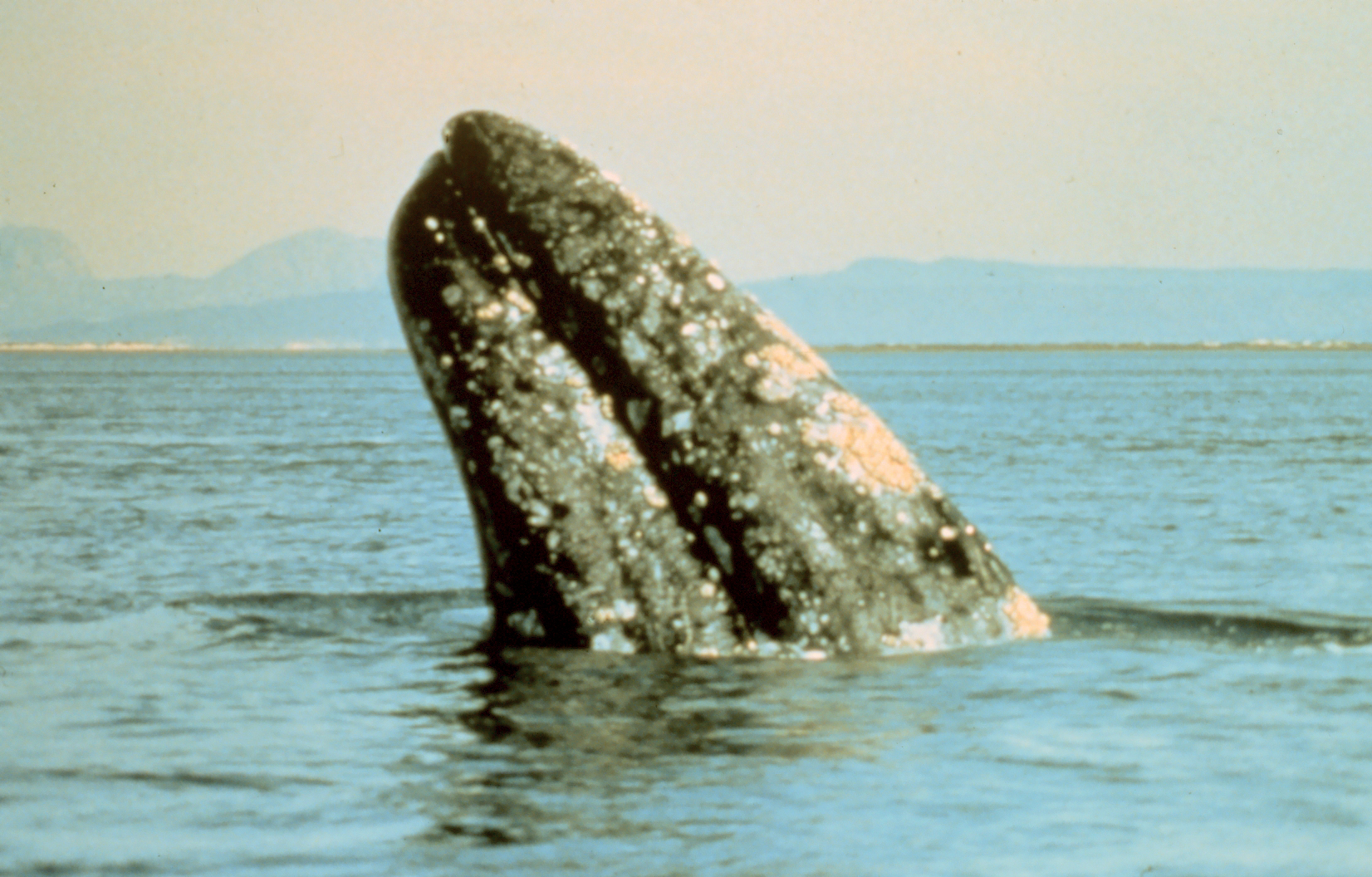
I had a chance to take my family on a three hour whale watch chartered out of Half Moon Bay on Sunday. After about an hour we wound up spotting several gray whales; baleen whales that I am told can grow to as large as 14 feet. For the most part, we were seeing the smoke-like "poof" of the whale expelling through its blow hole. My daughter was able to spot the fluke at one point. Then, suddenly, the larger gray jumped out of the water, exposing the majority of the whale's body to view. Amazing.
We did not get a picture of the whale, as each spotting was quite sudden. However, the overall effect was considerably more dramatic than the spotting photo I have linked to from Wikipedia.
On a slightly related topic, the migration of the blow hole to its present position on the whale's head is one of the more interesting parts of aquatic evolution.
Israeli Startup Panel (This Week!)
There's a panel in the Palo Alto area this week looking at Israeli startups with ties to silicon valley, organized by a local group CoolTech, this week. Israel (Tel Aviv in particular) is one of the few places that has been successful in transplanting the "American" venture capital model. Clearly, enlightened government policies had a formative influence on venture capital development in Israel, as did a business culture tolerant of risk and failure; it is also an incredibly exuberant business environment. In fact, when talking with Israeli VCs, I'm struck by how similar their outlook is to American VCs. And yet, there is undoubtedly more to the story. Israel's domestic market is small and the target for intellectual property is invariably external markets. The differences may in fact be more important than the similarities, since they open up new channels for discovering innovative business models. For that reason, Israel is an essential case study for economies around the globe that aspire to a dynamic technology marketplace.
Thursday, March 13, 2008
Creative Thinking in Private Equity
I recently had a chance to attend a meeting with a partner from Aventura Investment Partners as a part of a Wharton program looking at private equity in emerging markets, an area that I find extremely exciting. Aventura is doing several investments in Senegal, targeted at the value chain around agricultural production and also in health care. I can't go into the business models they are using right now, but there is some very innovative thinking required to bring development to areas like rural Senegal. As one of my Nigerian friends recently commented to me, traditional "aid" just hasn't worked. This is the kind of private initiative that has the chance to make dramatic and sustainable changes in a society. I imagine we will see a lot more funds take on challenges around development, especially if projects like these have success.
Monday, March 10, 2008
Civic Pride
Shamong was rated the 6th best town in New Jersey Magazine this year, owing no doubt partially to the fact that it is an attractive, quiet place, with a lot of nice people. Philadelphia magazine also showed that Shamong was one of the best residential towns in South Jersey for homeowners.
Gulag Archipelago
I try to read at least one novel a month to keep myself sane. Last month, I stumbled on an old hardback copy of Solzhenitsyn's Gulag Archipelago, which I picked up for 2 dollars in a used book store in New York City some 15 years ago and lost along the way. A riveting book that should serve as a reminder that humans are not inherently good. The book is a bit like reading Kafka's The Trial, until you realize it is not literature but a documentary.
Thursday, February 28, 2008
New Pan-African Venture Fund
Hasso Plattner just launched a new pan-African venture fund. Most of the venture investment I am aware of in Africa has been heavily concentrated in South Africa, though I have been hearing a lot about private equity in Nigeria from some of my African friends. Kenya was also looking like a beacon in east Africa until the recent lamentable political destabilization.
Thursday, February 21, 2008
Lunar Eclipse Picture

I was sitting at my computer in Redwood City worrying about the proper model for migrating composites from test to production systems when my colleagues from the integration team, Bo and Albert, called me over to Bo's office to see the lunar eclipse last evening. Pretty cool, though the eclipse was partially obscured by the cloudy weather in the Bay Area. Another friend, Deika, however, had a great view from Jamaica that she caught in a photo featured in the Telegraph. Wow!
Tuesday, February 19, 2008
Business Process Management fallacies
I missed this when it first came out a couple of months ago, in case you did as well: Dubray wrote an interesting analysis of problems in BPM from conceptualization to implementation that is worth reading.
I don't agree 100% with the model for linking BPMN models to BPEL, at least not as the only normative approach to consider, but the runtime model is spot on. The only meaningful model for executable business processes is going to require composite models that incorporate more than just rote BPEL mappings: business rules, human task management, and some form of message mediation. If that sounds familiar, you've probably started to look at the Oracle AS 11 SOA suite preview....
And JJ gets why SCA is so central to getting BPM right. We had a brief conversation about this recently, which I think may make it to Infoq over the next couple of weeks.
I don't agree 100% with the model for linking BPMN models to BPEL, at least not as the only normative approach to consider, but the runtime model is spot on. The only meaningful model for executable business processes is going to require composite models that incorporate more than just rote BPEL mappings: business rules, human task management, and some form of message mediation. If that sounds familiar, you've probably started to look at the Oracle AS 11 SOA suite preview....
And JJ gets why SCA is so central to getting BPM right. We had a brief conversation about this recently, which I think may make it to Infoq over the next couple of weeks.
Monday, February 18, 2008
The Next 4 Billion
I recently got a copy of the joint IFC and World Resources Institute report The Next 4 Billion. I am asking my friends in the technology sector to look carefully at the issues raised by this report: specifically, how to accelerate living standards, productivity and quality of life for the world's poorest using private sector resources and market-based mechanisms. Thinking in the developed world has changed radically in only a few decades: there is a genuine consensus that developing markets aren't there to be exploited, but to be developed into first-class market economies. Many (most?) of my friends are from emerging market countries, so I am confident this will be of interest to many of you.
I am convinced that business models are not yet there, but that that they are waiting to be unlocked by creative and innovative individuals. Since the problems with business oriented models aimed at developing markets is often one of scale, a big part of the solution is likely to be technology based. This is about developing a better future for humankind. Please give it some thought.
I am convinced that business models are not yet there, but that that they are waiting to be unlocked by creative and innovative individuals. Since the problems with business oriented models aimed at developing markets is often one of scale, a big part of the solution is likely to be technology based. This is about developing a better future for humankind. Please give it some thought.
Turning back time
A really interesting paper appeared in this weeks Nature. (Unfortunately, requires a subscription to access the full paper, but you can get a copy at a local bookstore.) The authors used phylogeny based statistical techniques to reconstruct ancestral proteins for several bacteria. The results independently show (and collaborate other evidence) for paleotemperature trends from as far back as 3.5 billion years.
Phylogeny based ancestral protein sequencing is not fool-proof, but the evidence seems convergent: the seas were considerably warmer billions of years ago (30 degrees Celsius seems likely) during the early development of life.
Phylogeny based ancestral protein sequencing is not fool-proof, but the evidence seems convergent: the seas were considerably warmer billions of years ago (30 degrees Celsius seems likely) during the early development of life.
Thursday, February 14, 2008
Systems Integration 08
Tracks and a call for paper have been announced for the Systems Integration 08 conference in Prague this year. This conference is extremely practical and in my experience has excellent content for IT practitioners. It is also a great opportunity to get some insight into what is happening in IT and software in central Europe, especially the Czech Republic and Slovakia.
Subscribe to:
Posts (Atom)